

Search:

301 Market Street
Lewisburg, PA 17837
570-524-0835 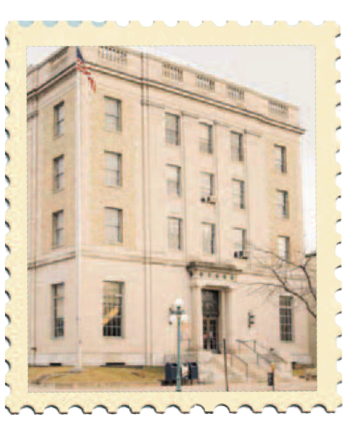
MURAL
Title: Old Time Camp Meeting
Artist: New Deal Muralist Robert Gates
Date: 1940
Medium: Egg Tempera on Canvas
Sometimes the Treasury Department constructed a building to house both a post office and a courthouse. This configuration is more prevalent in larger urban centers like Philadelphia and Pittsburgh, but can sometimes be found in smaller towns like Lewisburg.
In this case, the building must express the dignity and solemnity of the judicial system. The four-story neoclassical building, the tallest on Market Street, dominates the heart of the business district. The Post Office/Courthouse distinguishes itself from its commercial neighbors by the 10-step elevated entrance, massive Doric columns and brass doors. And yet, while clearly expressing its importance, the building harmonizes with the nearby First National Bank and Open Discourse Coalition buildings (formerly Omega and Sovereign banks) which also employ neoclassical columns and detailing.
The Lewisburg Post Office/Courthouse and nearby banks form an impressive grouping of neoclassical buildings in the center of town. It is larger and taller than the surrounding buildings, expressing its importance as a center of federal activities. Details, such as the massive Doric columns of the Open Discourse Coalition building and the decorative balustrade at the roofline of First National Bank, are echoed in the Lewisburg Post Office/Courthouse.
10 North 4th Street
Mifflinburg, PA 17844
570-966-0501 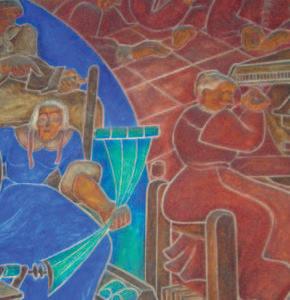
SCULPTURE
Title: Pioneers of the Community
Artist: (Marguerite) Bennett Kassler
Date: 1941
Medium: Plaster reliefs
In this series of panels, the women are carding, spinning, weaving yarn and preparing food, and the men are hunting, plowing and laying brick. The installation of this work is unusual in that it was designed to be placed above the long wall above the clerks’ windows instead of on the short wall above the postmaster’s door. Composed of four plaster panels — two squarish center panels, flanked by two narrower rectangular ones — it spreads across the wall above the window clerks. Men, shown hunting and building, are on the left, while the women cook and serve, and weave and spin on the two right panels. The outermost flanking panels are painted in nearly monochromatic earth tones, focusing attention to the center by the directional gaze of the subjects. The center panels include brighter colors and are formally united by a blue semi-circle in the background. This work is much more stylized than the other sculpture in the area. The planes of the surfaces tilt and overlap. The figures are shown in profile or frontally, with simplified contours, like stained glass windows, and like Henry Chapman Mercer’s tile mosaic floor in the Harrisburg State Capitol.
About the post office: The Mifflinburg post office is a charming Colonial-revival style building. Unlike many other post offices from this era, the lobby is largely intact and remarkably well preserved. A few years ago a group of residents formed to landscape the property. They also successfully lobbied to have the building restored. The roof, copula, entrance doorway, and windows were replaced with materials similar to the originals.
29 North Front Street
Milton, PA 17847
570-742-7301 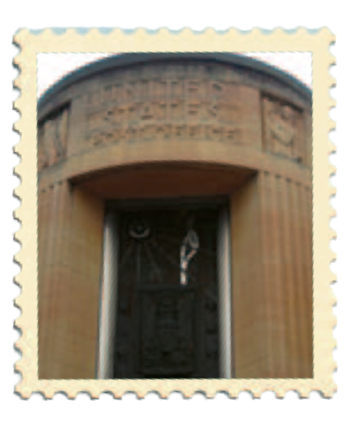
SCULPTURE
Milton topography (bronze plaque)
Native Americans (2 reliefs), Mail transportation (5 reliefs)
Artist: Louis A. Maene
Date: 1936
Medium: Bronze and limestone
This is the only example of exterior decoration in the region. Five bas relief panels represent the past and present modes of mail transportation and two show Native Americans. The most successful post office artworks always incorporate the architecture into their design. The Milton post office best demonstrated this principle, since the sculpture is actually part of the facade. The artwork, commissioned under the Treasury Relief Art Project, allowed the architect, Harry Sternfeld, to work with a sculptor of his choosing, rather than having to rely on an artist selected by competition. Detailed drawings of the relief sculptures in the blueprints suggest that Sternfeld may have designed them as well. 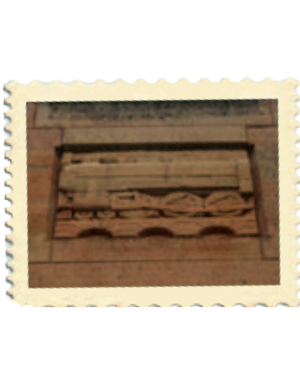
Harry Sternfeld, (1887–1976) a Philadelphia native, received his undergraduate and graduate degrees at The University of Pennsylvania. In addition to the Milton Post Office, Sternfeld designed the William Penn Annex Post Office and Courthouse (Philadelphia, 1941). It is interesting to see Sternfeld’s 1934 sketches for the William Penn Annex published in the architecture magazine Pencil Points. It shows a building very much like Milton’s post office: an Art Deco structure with rounded corners, a pronounced entrance facade off to the left, and decorative bas reliefs above tall windows. The Annex, as built in 1941, is in the “classical moderne” style. While it lost the more distinctive Art Deco elements, it does have four stone reliefs representing mail delivery around the country, flanking two entrances. The Milton post office is really a smaller scale version of what might have been built in downtown Philadelphia.
The Milton post office is one of a few in the region which is not based on stock Treasury department plans. This is very unusual, as most private commissions, like the William Penn Annex, were reserved for larger cities.
75 Queen Street
Northumberland, PA 17857
570-473-3581 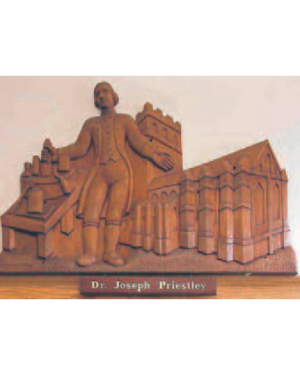
SCULPTURE
Title: Dr. Joseph Priestley
Artist: Dina Melicov
Date: 1942
Medium: Red mahogany relief
This sculpture depicts the town’s most famous citizen, Dr. Joseph Priestley (1733–1804). Priestley was born in England near Leeds but his political and religious views were unpopular in his native country. He was a supporter of the French and American revolutions and a liberal pastor of a small dissenting church. Priestley left for America after an angry mob burned his house, eventually settling in Northumberland in 1794. Inspired by his friend Benjamin Franklin, Priestley began scientific experiments involving electricity and chemistry. Joseph Priestley is most famous for discovering oxygen. He also isolated and described the properties of ammonia, sulphur dioxide, hydrogen sulfide, carbon dioxide, and carbon monoxide. Priestley also discovered that India gum could rub out pencil marks and thus invented the eraser.
Artist Dina Melicov depicts Joseph Priestley flanked by symbols of his life’s work. On the left is the workbench Priestley used in his Pennsylvania laboratory. The portion on the right depicts Priestley’s church.
Joseph Priestley’s house and laboratory are maintained as a museum by the Pennsylvania Historical and Museum Commission.
About the post office: Northumberland’s charming post office with its wood detailing is reminiscent of the vernacular wooden houses and railroad buildings in town.
100 South Market Street
Selinsgrove, PA 17870
570-374-4821 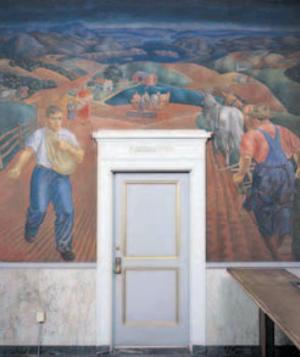
MURAL
Title: Susquehanna Trail
Artist: George Rickey
Date: 1939
Medium: Tempera on canvas
This beautiful mural depicts spring plowing and planting in central Pennsylvania, combining richly detailed subject matter with a dramatic use of the lobby space. The artist, George Rickey, decided in his early sketches to cover more wall by having his mural wrap down around the postmaster’s door. This allowed his two farmers to be painted nearly life size. The planting farmer on the left is very close to the picture plane and appears to be ready to step onto the lobby floor, circle the postmaster’s door, and follow the other farmer plowing into the distance. This trompe l’oiel effect incorporates the lobby; rather than being a detriment, the narrowness of the space enhances the rapidly receding horizon of the mural.
The background includes Shriner’s Church, the Susquehanna River, Selinsgrove and the Mahanoy mountain. In the middle ground is a woman, infant, and child. The letter that the woman holds as well as the rural mail box behind her, symbolize the Post Office Department’s duty “to bind the nation together by mail.” Rickey does not depict tractors which would have been used, or at least desired, by many farmers; he presents, instead, a romanticized, nostalgic view of farming.
Rickey’s mural skillfully integrates many elements which were so popular in Depression-era murals: images of working men, motherhood, fertile land, and a strong community. In the midst of the Depression, his mural presented a stable present and a promising future.