Search:
Mifflinburg Celebrates Buggy-Making Heritage
By: Lisa Z. Leighton
Previously printed in Lancaster Farming; reprinted with permission by the author.
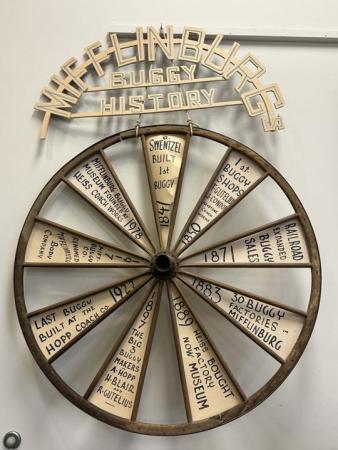
Mifflinburg, Pa. – Located just nine miles west of the bustling college town of Lewisburg and Bucknell University, is a serene historic downtown that takes pride in its buggy-making history. Since the 1880s, Mifflinburg has been known as “Buggy Town” because it had more than 80 documented buggy makers at the time they were making them. They had more buggy makers per capita than any other town in the country, making about 5,000 buggies each year.
Today, the buggy’s influence in Mifflinburg can still be seen in the preserved history at the Buggy Museum and the buggy traffic of the Amish and Mennonite communities.

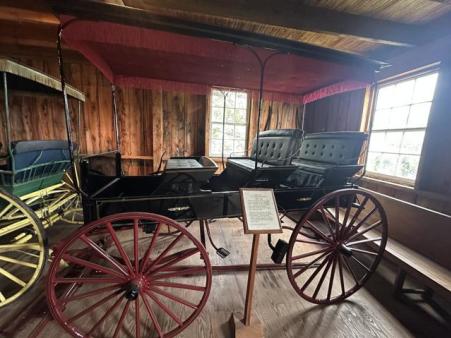
A spring wagon crafted between 1883 and 1920.
Photo credit: Lisa Z. Leighton.
Eva Linke, Board President of the Mifflinburg Buggy Museum said, “What sets the Museum apart is the authenticity of our exhibits, including restored buggies, and the original Heiss Buggy Shop where they were built. We offer a unique glimpse into the craftsmanship, innovation, and culture that shaped our town’s identity.”
The Mifflinburg Buggy Museum features the family home of the William Heiss family, plus a carriage house, factory, and showroom. The Buggy Museum is the only intact, original buggy shop from that era that is open to the public for viewing. A newly-built Visitors Center is also located onsite, featuring interactive displays and a gift shop.

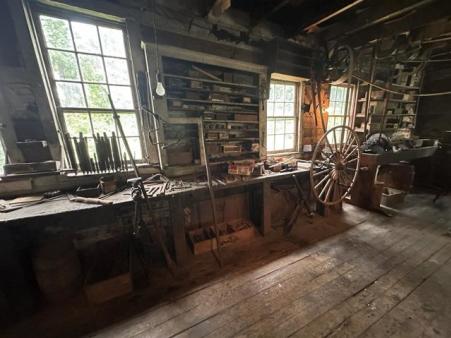
The workshop where buggies were made.
Photo credit: Lisa Z. Leighton
From 1883-1920, Heiss manufactured carriages, wagons, and sleighs. When his buggy business declined, he sought out other opportunities to make a living, including furniture maker, beekeeper, and automobile painter. Heiss also rented out bicycles, horses, and buggies and sold stoves.
The carriage factory has original tools and machinery, as if it was frozen in time. Visitors can see a woodworking room, blacksmith room, painting room, drying room, and upholstery room.
The Heiss home is furnished as it would have been in the late 19th and early 20th centuries, including the kitchen, living room, dining room, family game room, bathroom, and bedrooms.

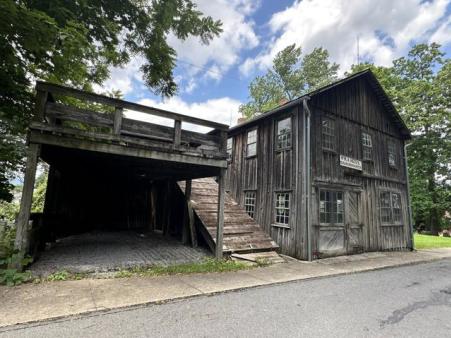
The exterior of the W.M.A. Heiss Coachmaker shop.
Photo credit: Lisa Z. Leighton
The showroom, or repository, boasts buggies made by Heiss himself, as well as other locally-produced buggies including brake carriages, surreys, doctor’s buggies, two seat spring wagons, special sleighs for snow called Albany Cutters, a mail buggy and a recent, 2022 acquisition: 1916 Ford Country Suburban, donated by the Samartin family from Texas.
Linke said, “Among our most treasured items are the original buggies built in the Heiss Buggy Shop, including rare models that tell the story of innovation and design. We also feature antique tools, blueprints, and machinery used by the local craftsmen, which offer visitors a detailed look at the craftsmanship behind these iconic vehicles. Additionally, we have personal items, photographs, and documents that reflect the lives of the workers and their families, giving a human touch to the historical narrative.”

The exterior of the W.M.A. Heiss Coachmaker shop.
Photo credit: Lisa Z. Leighton
Thanks to the tireless work of a core group of volunteers, the Buggy Museum paid off the Visitors Center mortgage in November 2024. The Rusty Rail Brewing Company gave the final boost needed to reach the milestone, Linke said.
The Board is now focused on establishing a $1 million endowment fund to ensure the organization has the resources it needs to maintain historic buildings, continue educational programs, and enhance the visitor experience.
Linke said, “The endowment is crucial because it ensures the long-term sustainability of the Mifflinburg Buggy Museum. It’s about establishing a solid financial base to preserve and share this remarkable piece of history with future generations. Every contribution, no matter the size, makes a meaningful impact and helps us keep this unique piece of Mifflinburg’s history alive.”

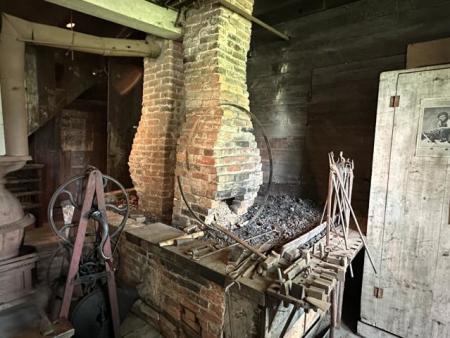
This fireplace served as a soldering area to shape wheels and other parts.
Photo credit: Lisa Z. Leighton
Recent gifts and acquisitions by the Museum include a Mifflinburg Buggy Company sleigh that was made at what is now Rusty Rail Brewing Company, a Hopp Carriage Company sleigh that was on display at the Mifflin County Historical Society and donated by Allen and Beth Myers of Huntingdon, a collection of maker tags from various buggies and sleighs that were made in Mifflinburg, a Heiss buggy from Argyle, a William F. Brown doctor buggy, and a William F. Brown governor’s carriage.
Linke said, “The museum isn’t just a collection of artifacts—it’s a way to honor the stories of the people who helped shape the town, and being part of that [as a volunteer] is truly special.”
While in Mifflinburg, consider checking out the preserved Gutelius House, the historic Elias Church now serving as a Performing Arts Center, and Rusty Rail Brewing Company. Originally built in 1911, at one time Rusty Rail was where buggies, carriage bodies, gears, axles, and automobile bodies were assembled. Today it is Central PA’s largest brewpub featuring well-appointed suites for overnight accommodations.
The Mifflinburg Buggy Museum offers guided tours that are approximately one hour long, Saturdays and Sundays from 1-4 p.m. May through October. They also host Buggy Day, the second Saturday in June, annually.
Admission is $10 ages 17+ and $5 ages 6-16. Free parts of the Museum include an informational room, video, and gift shop.