

Search:

By: Lisa Z. Leighton
Previously printed in Lancaster Farming; reprinted with permission by the author.
Danville, Pa. – Once again, the Danville Heritage Festival featured a plethora of free events for the community to learn more about local history and heritage traditions. Activities included living history demonstrations, historic walking tours, live music, craft and food vendors lining Mill Street, and historically-themed talks by local experts.
One well-attended talk, “PA Dutch Holiday Traditions”, was presented by Danville Middle School Social Studies teacher Mark Shifflet at the Thomas Beaver Free Library to a group of 40 attendees.
Shifflet, who is part Pennsylvania German, started studying Pennsylvania German history and culture in college.
While many people think of Lancaster as Pennsylvania Dutch country, the region that immigrants encompassed is much larger, including all of southeastern Pennsylvania and most of central Pennsylvania.
Shifflet noted the settlement zone was about the size of Switzerland, especially if you include locales in Maryland, Ohio and Virginia where many descendants of the Pennsylvania Germans moved.
He said the term “Dutch” can be confusing; it does not refer to the Netherlands, but rather to a dialect, “Deitsch.”
“When we think Dutch, we usually think about Holland, but most Pennsylvania Dutch come from the upper Rhineland of Southern Germany, the Alsace region of France and northern Switzerland around Zurich. These people in the Rhine Valley emigrated to the United States the late 1600s and early 1700s,” Shifflet said.
They immigrated to Pennsylvania because they were looking for religious freedom, more employment opportunities, and to escape war.
Shifflet said a very small percentage of Pennsylvania Germans are Amish and Mennonite.
Shifflet organized the presentation by seasons, beginning with winter holiday traditions. He said that while we celebrate Santa Claus bringing gifts to children today, in the 18th century it was Christ-Kindel, or later Kriss Kringle, who would magically fill stockings with treats. 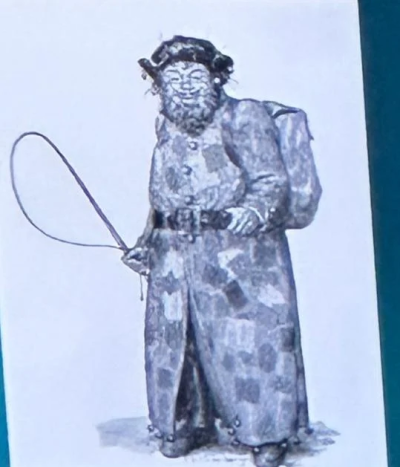
Later in the 19th century, Der Belschnickel, of which there were two different traditions, appears. In urban areas like Reading, Lancaster, York, Lebanon or Harrisburg children would have something akin to trick-or-treat, where, according to Shifflet, “People would put on masks and go from house to house, cause trouble, and demand Christmas cookies or other refreshments, and cause a lot of trouble on the evenings around Christmas time.”
Shifflet said the most famous Belschnickel tradition was of “the lone wolf” – he was a solitary, eccentric character who traveled alone to visit homes before Christmas, unlike the jolly and social Santa Claus.
Shifflet said the character also had a darker side – parents would send their children to bed early in the hopes that they wouldn’t receive a flogging from Belschnickel himself.
Christmas trees were present, but they had a smaller size and importance, “Pennsylvania was one of the earliest places in America to have [tabletop] Christmas trees…Decorations included cookies, walnuts, and crabapples.”
Speaking of treats, Christmas treats traditionally included gingerbread, apees, sand tarts, doughnuts, mince pies, marzipan, hard molasses taffy, and believe it or not, oysters.
Christmas was also a time of folk magic, “It was common to lay the next day’s hay in the barnyard overnight on Christmas Eve, so it would collect the dew Christmas morning. If you fed that to your cows, that would keep them healthy that year,” Shifflet explained.
He said each religious holiday tended to have a large, secular holiday the day after, for antics such as shooting matches.
“The next most famous Pennsylvania Dutch holiday is probably Groundhog Day, which takes place on February 2,” said Shifflet.
The celebration came from an ancient weather forecasting tradition of when to plant – and it started with badgers in Germany.
Shifflet said the tradition of Daylight Savings was a dreaded tradition to the PA Dutch, “Daylight Savings, which was introduced in 1918 was resisted by the Pennsylvania Dutch as being unnatural: you can’t just change the clock, that’s unnatural, and so they called it Devil’s Time.”
In the late winter/early spring was St. Patrick’s Day, “Once this large-scale Irish immigration comes to the Americas in the 1830s and 40s, along comes St. Gertrude’s or St. Patrick’s Day and a lot of planting lore: you’ve got to get your onions and your potatoes and your peas in the ground. All your early stuff should be in the ground by St. Patrick’s Day.”
Also common at that time, on St. Gertrude’s Day, “You’d make a special bread called a Datsch and you would tear pieces of it and crumble the crumbs in the four corners of your garden as an offering to the little people to make sure that your garden didn’t get too many insects in it.”
Shifflet talked about the popularity, even today, of Faschnacht Day or Shrove Tuesday, but there was a practical reason for it, “The goal was to try and get rid of all your fat before Lent.”
He read from an 1884 article, “The lard in which the cakes were fried would be preserved as possessing extraordinary virtues in healing. Wagons also were greased with it…some folks greased their garden space…in the belief that the practice would protect the vegetables from harmful insects and bugs.”
He said that on Ash Wednesday, the goal for kids was to get up early, because the last one up had to clean the coal stove at home and at school. He noted folklore around the “magical properties” of the ashes – they were sprinkled on the farm animals and chickens to prevent lice.
Maundy Thursday was a day set aside to eat bitter greens like dandelion, “Only the Pennsylvania Dutch can make a salad unhealthy,” he said kiddingly, referring to the hot bacon dressing of vinegar, sugar and beaten eggs that is typically slathered on top of the greens.
He noted that the reason for this tradition was because grocery stores were not readily available, “…The last time you saw a green vegetable was probably the late kale or collard greens in December, so by the time Maundy Thursday rolls around, you haven't eaten any green vegetables. These are things that you were breaking your fast with: some fresh vegetables. Can you imagine having so little access to fresh vegetables that you actually want to eat them? That’s what it was like. They had been eating pork and sauerkraut for three months.”
Shifflet noted that old time Pennsylvania Dutch are Sabbatarians – they don’t work on Sundays, and Good Friday was an extra Sabbath to them.
Easter Sunday was for church services followed by egg dying and hiding. Dyes were made from onion skins (yellow), hickory bark (yellow), green wheat (green) and coffee or walnut hulls (brown).
He said they would sometimes wrap them in Calico cloth with a pattern to imprint the color of the dye from the cloth onto the egg or use tallow to make designs on the egg where the dye would not adhere.
Ascension Day was the holiest day of the entire year to this group – all work was forbidden, especially sewing, “If you sowed on Ascension Day, you were going to get struck by lightning,” was a typical belief.
Two of the only activities that are acceptable on that day are fishing and gathering herbs.
Shifflet also spoke about Battalion Day, highlighting historical practices and their cultural impact, and Harvest Home Service, a PA Dutch tradition akin to Thanksgiving, which was held in late September or early October, involving community produce decorations and food distribution to the pastor or the congregation board. Other communal activities included butchering, apple schnitzing and apple butter boiling. The old schoolhouse was a site for Halloween pranks, marking the transition to winter and the approach of Christmas once again.